by James | 6 Jun 2017 | Newspaper Issues, Legislative, Newspaper, Featured Stories, 2017
By: Peter Owens
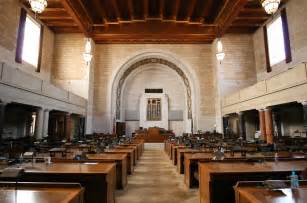
The Government of Cornhusker Boys State is poised to begin active service after a year of recess. Returning from the previous session is Governor Ruben Aguilar, a graduate of Lincoln North Star High School. Joining him will be the newest delegation of the Cornhusker Boys State Legislature, who will soon begin to campaign in each of their individual towns. Together, they will debate, pass, and ultimately sign a plethora of new legislation into the law books of this great state.
Many groups from all across the state will be looking to pass legislation on a number of issues. These issues range from the death penalty to the legalization of marijuana, to the manner in which Boys Staters are tucked into bed each night.
The Death Penalty is poised to be a object of large contention at this years Boys State. After a November ballot measure overturned the previous ban of the practice legislators on both sides of the issue will seek to address this issue. The argument in many cases boils down to public safety for many supporters of the action. They argue that the death penalty is needed to punish the most heinous of crimes, as well as provide further punishment while in prison to protect the safety of prison guards, especially after the prison riots that have taken place in the Nebraska prison system. Detractors argue that the death penalty does not actually work to stop people from committing these crimes, and that life in prison is an adequate sentence in almost every case. Another key issue is the scarcity of the lethal injection drugs needed to execute a sentence.
The legalization of marijuana is a debate that has begun in almost every state across the country. States like Colorado and Washington, among others have legalized recreational marijuana while even more have legalized just medical marijuana. The argument for this proposition rest mainly on the personal liberties of the citizens of the state. They argue that the state should not put people in prison for using a drug that does little to actively hurt anyone else, especially when drugs like alcohol are widely abused and legal. They opposition show the negative affects that marijuana has on the brain, especially in those still developing. The societal affects, they argue, far outweigh the threat to liberty argued by the supporters.
Lastly, the legislature looks set to debate the “nighty-night” bill once again. This landmark piece of legislation will shape the way that the Boys Staters interact with their counselors for the entire week. The act of tucking each Boys Stater into bed will create a lasting sense of community and ensure that not Boys Staters are engaged in any kind of illicit nocturnal activities. The opposition to this legislation again rests in the debate of personal liberties, as some argue it is a breach of privacy.
In the end, the Cornhusker Boys State government will elect legislators to debate these key issues. The democratic process that is at the bedrock of our nation will work to solve the issues between the citizens of our state and the legislature will vote to pass meaningful legislation.
by Brad | 6 Jun 2017 | Top Stories, Featured Stories, 2017
Everyone you meet is fighting a battle you know nothing about. Be Kind. Always.
During Dr. Jo’s keynote address Monday evening she shared the touching story of her husband “Red” and an unexpected hug she received just two weeks after he passed. When Raymond “Red” Nauslar passed away on May 12th, 2014 Dr. Jo made the decision to still attend Boys’ State and give her keynote session, as she had numerous times. At the end of her 60 minute presentation, even though she gave her speech with the same energy and excitement as always, a Boys’ Stater sitting in the front row of Kimball Hall, an citizen of Alamo, raised his hand and said it looked like she needed a hug and asked if it would be alright if he gave her one. As Dr. Jo recalled tonight, that hug was the exact reason she decided to still speak to the delegates. “I needed you more than you needed me. I needed that hug.”

After Dr. Jo finished her talk and she walked back stage, she was greeted by counselors and staff congratulating her on another successful year when senior counselor, Landon Schmitt, approached her and let her know he was the stater 3 years ago who, while wearing the same color as her husband’s name, asked a simple question, but one that meant the world to a person in need. Dr. Jo’s face lit up and she embraced him. They spoke for a minute before Dr. Jo grabbed him by the hand and ran back out on stage to proudly introduce him to the delegation.


Landon Schmitt and Dr. JoAnne Owens-Nauslar
by Schuyler | 7 Jun 2016 | Featured Stories, 2016
Senator Ben Sasse made one point throughout his address to Boys’ State. The current Senator from the state of Nebraska drove home that the future of jobs will require no singular skill set. He claimed that employees will require the capability to shifting between specializations. Artificial intelligence and automated production will likely take over major industries throughout the United States. This shift is similar to the historical revolution of agriculture. These shifts required individuals to acquire a specialized skill set within their jobs, artificial intelligence will drive the millennial generation to be continuously evolving to be dynamic in any given direction. Sasse also mentioned an educational upheaval, where universities adapt to allow older students to take classes while supporting a family. This may be necessary for a fast moving and faster growing economy.

by Kyle | 3 Jun 2014 | Top Stories, Featured Stories, Gettysburg, 2014
Colten White, Gettysburg, Kearney High
Starting off the race for the Nebraska Senate general election, Democrat Dave Domina and Republican Ben Sasse offered their perspectives on several issues for an audience consisting of both 2014 Boys’ and Girls’ State Delegates. The two candidates began the forum with opening statements. Domina’s primary message throughout his introduction consisted of a theme for an “honest country.” This was driven home through the use of multiple examples, ranging from the banking crisis to the Keystone XL Pipeline. While no official rebuttals were allowed during the forum structure, Sasse offered a conflicting introductory theme that opposed “promises that don’t add up.”

The first question of the evening revolved around domestic surveillance. Beginning the discussion, Domina flatly stated that the use of Drones against U.S. citizens, at home and abroad, as well as the collection of metadata by the NSA, are not permissible. Stating that he “fundamentally disagrees” with the Obama administration on this issue, Domina appeared to distance himself from his party’s national leader, possibly due to the fact he is running as a democrat in a solidly republican state. One criticism that both candidates shared the burden of throughout the forum was the trivial back-and-forth over the categorization of the U.S. as either a republic or a democracy, something better left to an eighth grade civics course than a senate race. Sasse differentiated his opinion by stating his agreement with the use of drones in most cases. He agreed with his opponent on the illegitimacy of the NSA.
Continuing with the evening was the question of the federal government’s role in the legalization of marijuana and gay marriage. Sasse began his response with a declaration of support for traditional marriage, and boldly stated that some studies show that kids are best raised in an environment with a father and a mother. No studies were cited, and Domina also questioned the legitimacy in his response, stating that he has never seen any data to support Sasse’s claim. Sasse left the issue of marijuana up to the state lawmakers. Domina contradicted this view, stating that the federal government has a duty to correct issues between states such as Nebraska and Colorado on the legal/illegal transport of marijuana. Domina placed his stance on marriage in support of decisions made by states, rather than by nature.

In terms of the ever constant struggle between fossil fuels and the environment, the candidates offered differing views once again. In an extremely progressive environmentalist stance, Domina called for a “complete and total” repeal of federal subsidies for fossil fuels, and supported the reallocation of those appropriations for renewable energy. Impacting his case in strong manner, Domina stated that the younger generations will see the negative effects of climate change. Sasse, on the other hand, went with a very run-of-the-mill conservative approach to the energy debacle. He stated that the federal government should stop the “war on coal,” and fully use all fossil fuels available in the U.S.
Seeing that Sasse is one of the premier opponents of the Affordable Care Act (ACA), it made sense to include it among the questions for the forum. While huge amounts of discussion time were devoted to this subject, it can be summed up simply. Sasse supports the full repeal of the ACA, while Domina supports continuing to work on reforming the bill.
The final two questions tackled very different issues. The second to last question discussed Education and Student Loans. Sasse greatly opposed the common core education plans, but defined the federal role more in terms of grants. Domina urged the electorate to trust teachers and help relieve student loan debts. While he disparaged debts owed to for-profit institutions, it could be said that Domina ought to have focused more on debt owed to all institutions, even public universities.

The final, and possibly the most intriguing, question of the night was in regards to party polarization and gridlock. Domina used harsh anti-party language that in many ways was a brilliant critique of the party alliances that exist in the current political climate. He detested the “tribal” language of political parties, and urged everyone to drop labels when discussing ideas and policy. He stated that parties have no inherent utility or value, and that they should only exist to facilitate discussion. Sasse offered a more moderate approach, saying that Washington needs fewer savvy politicians, and more figures who are connected to the people. Despite these similarities, he lacked the vigorous critique of the party culture that was employed by Domina.
While the closing statements offered little new information, both candidates brought to a close the end of the beginning, for the 2014 Nebraska senate general elections. All in attendance have witnessed the beginning of a saga that will last several months until the general elections take place. There was possibly no better place to start this race than at Boys’ and Girls’ state.
by Mike | 8 Jun 2012 | Legislative, Featured Stories, 2012
Speaker of the Nebraska Legislature Mike Flood addressed Cornhusker Boys’ State delegates on Thursday evening to give them a practical framework and knowledge of how Nebraska’s unicameral legislature works. Senator Flood explained how there are forty-nine Senators in the Nebraska Legislature representing forty-nine districts in Nebraska, each consisting of approximately 37,000 people. He went on to discuss the workings of the legislature. In odd years, legislators spend 90 days in the legislature, and in even years, 60 days. To pass legislation in the Unicameral, twenty-five votes are needed, and thirty are required to overturn a Governor’s veto. As speaker, Flood is responsible for enforcing rules and ensuring that proper procedure is followed. After discussing this infrastructure, Flood went on to briefly address some of the recent issues considered by the State Legislature, including the budget, the death penalty, and the Keystone XL Pipeline.
Cornhusker Boys’ State was pleased to welcome Cornhusker Boys’ State Alumnus Mike Flood to this session.


